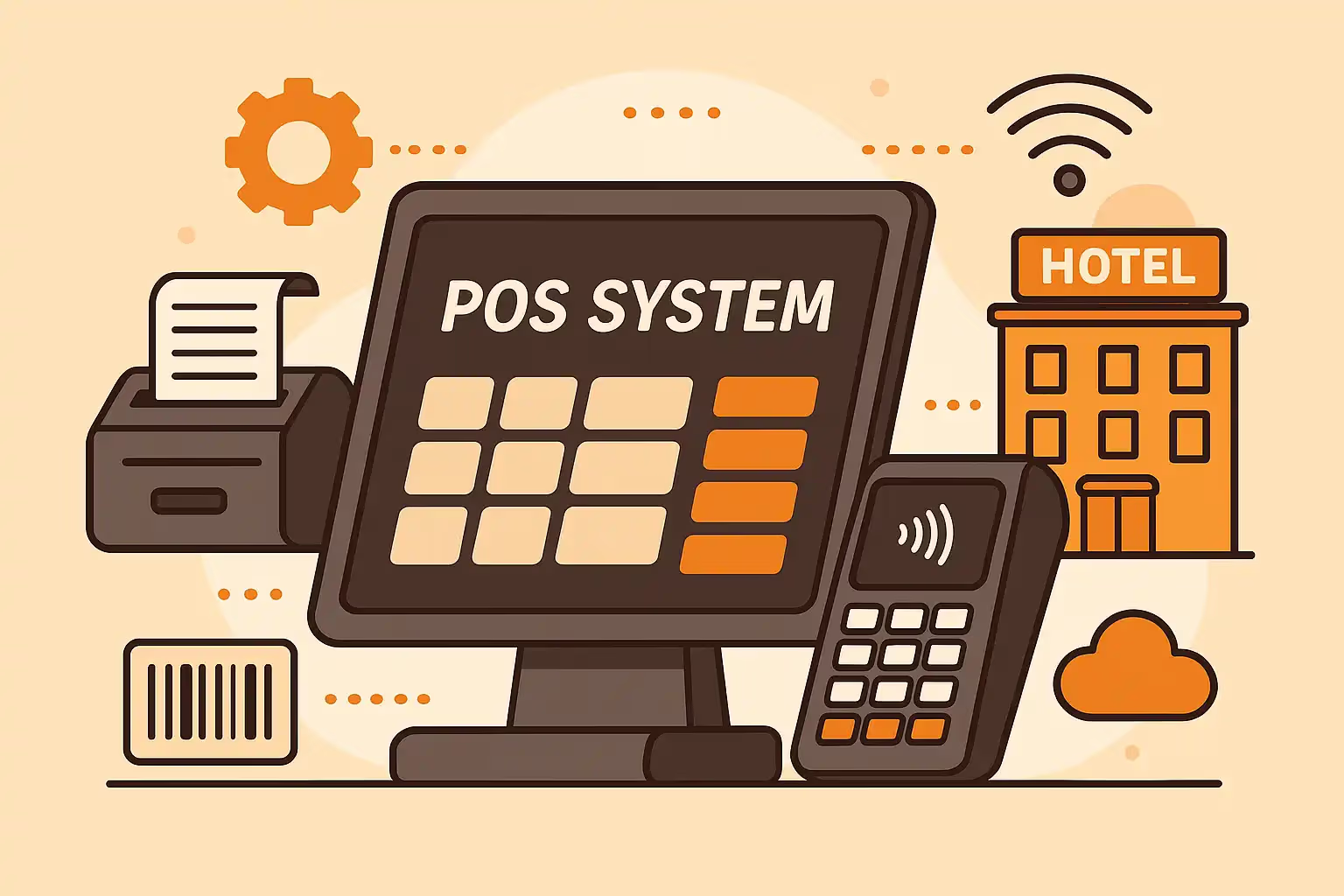
A modern hotel POS system is much more than a tool for processing payments. It supports day-to-day operations across restaurants, bars, room service, spas, pools, and other outlets, helping staff manage orders, inventory, payments, and guest charges from a connected platform. As the hospitality POS software market continues to expand, the technology is increasingly becoming an operational layer rather than simply a checkout solution.
Effective hotel POS software connects sales, guest services, inventory, and financial data, giving hotel teams a more complete view of operations. Yet integration remains a challenge: a 2025 hospitality technology survey found that only 24% of hotels reported full integration of their core systems, while 42% still relied on disconnected systems.
Choosing the right features, therefore, can directly influence efficiency, guest experience, and revenue management. With the global hotel POS terminal market projected to grow from $5.58 billion in 2025 to nearly $10 billion by 2033, selecting a scalable, well-integrated system is becoming increasingly important for hotels planning for long-term growth.
What Core Features Should Hotel POS Software Include?
A hotel POS should support much more than basic payment processing. It needs to connect the different revenue-generating areas of a property and make everyday transactions easier to manage. Essential functionality typically includes:
- Payment processing: Support for cards, cash, digital wallets, split payments, refunds, and other payment methods.
- Order and billing management: Fast order entry, bill customization, discounts, tips, refunds, and direct posting of charges to guest room folios through PMS integration.
- Multi-outlet support: Management of restaurants, bars, room service, spas, pool areas, and retail outlets from a centralized system, while allowing each outlet to maintain its own menus and pricing.
- Inventory management: Real-time tracking of ingredients and products, automatic stock updates after sales, low-stock alerts, and inventory movement across outlets. This helps reduce overstocking, shortages, waste, and manual stocktaking.
Employee management is another important component. Role-based permissions can determine which transactions and functions each employee can access, while individual logins, shift management, and transaction histories give managers greater control and accountability. These tools can also help identify unusual discounts, refunds, or voids and simplify staff performance tracking.
Finally, reporting and analytics should turn POS data into actionable insights. Managers should be able to monitor sales and revenue by outlet, best- and worst-performing products, inventory levels, staff activity, and overall outlet performance through dashboards and automated reports. Real-time visibility makes it easier to identify trends, control costs, adjust menus or staffing, and make faster revenue decisions.
Which Advanced Features Can Make a Hotel POS More Powerful?
Advanced hotel POS software can become a central part of the property’s technology ecosystem when it connects with the other systems used to manage the guest journey and hotel operations. Instead of keeping sales, guest, and financial information in separate platforms, integrations allow data to move automatically between the POS, PMS, accounting software, payment gateways, CRM, online ordering platforms, and other tools. For example, PMS integration can enable restaurant or bar charges to be posted directly to a guest’s room folio, while accounting integrations reduce manual reconciliation and duplicate data entry.
Features That Enhance the Guest Experience
The right POS should also make interactions with the hotel more convenient and personalized. Useful features include:
- Room-charge functionality for posting restaurant, bar, spa, or other purchases directly to a guest’s folio.
- Tableside ordering and payments that allow staff to take orders, send them to the kitchen, and process payments without returning to a fixed terminal.
- Loyalty integration that lets staff recognize returning guests and apply relevant rewards or promotions.
- Guest profile access that can surface preferences and other relevant information, helping employees provide more personalized service.
- Mobile and online ordering, including QR-code menus and room-service ordering, giving guests more flexibility in how they interact with hotel outlets.
Cloud and Mobile Accessibility
Cloud-based and mobile POS capabilities give hotel teams greater flexibility to manage operations from different locations and devices. Staff can use tablets or mobile terminals at restaurant tables, poolside areas, events, or other locations instead of being tied to a fixed counter. Meanwhile, managers can access sales reports, monitor outlet performance, and review operational data remotely. This is particularly valuable for multi-outlet and multi-property businesses that need centralized visibility without being physically present at every location.
For hotels with complex or highly specialized workflows, an off-the-shelf POS may not cover every integration or business requirement. COAX Software develops custom hospitality and hotel technology solutions that can connect POS functionality with existing PMS, booking, accounting, CRM, and other systems, creating workflows tailored to a property’s specific operations. Its hotel software development expertise includes POS integration, folio management, cloud and mobile solutions, and multi-property functionality.
How Do You Choose the Right Hotel POS Software?
Choosing a hotel POS should start with the property’s actual operational needs rather than a long list of advertised features. A small boutique hotel with one restaurant may need a simple, easy-to-use system, while a large resort with multiple restaurants, bars, room service, and spa outlets requires stronger multi-outlet management, integrations, and centralized reporting. Hotels should also consider their growth plans and choose a platform that can support additional outlets, properties, users, and transaction volumes without requiring a complete system replacement.
When comparing solutions, hotels should evaluate:
- Scalability: Can the system support more outlets, users, transactions, and properties as the business grows?
- Ease of use: Is the interface intuitive enough for staff to learn quickly and use efficiently during busy periods?
- Integration capabilities: Can it connect with the PMS, accounting software, payment providers, inventory systems, CRM, and other tools? Two-way, real-time integrations are particularly important for avoiding manual data transfers.
- Security: Does the platform provide appropriate access controls, secure payment processing, data protection, and reliable backup mechanisms?
- Vendor support: Consider implementation assistance, staff training, technical support availability, software updates, and how integration issues are handled.
Hotels should prioritize workflow fit over feature count. A POS with dozens of advanced capabilities is not necessarily a better choice if employees struggle to use it or the system does not support the property’s specific processes. During demonstrations, it is useful to test real scenarios—such as processing a room charge, splitting a bill, transferring an order between outlets, handling a refund, or generating end-of-day reports—to see how naturally the software fits existing workflows.
Finally, evaluate the total cost of ownership (TCO) rather than comparing subscription prices alone. Include hardware, implementation, integrations, training, payment processing, support, maintenance, and potential upgrade costs. Then compare these expenses with expected benefits such as reduced manual work, faster service, fewer errors, better inventory control, and increased revenue. This approach helps hotels select a POS that delivers measurable ROI rather than simply choosing the cheapest or most feature-rich option.
Choose a POS That Grows With Your Hotel
The right hotel POS software can do far more than process payments. Core features such as order and billing management, inventory tracking, employee controls, multi-outlet support, and reporting help staff work more efficiently, while advanced capabilities like PMS integrations, room charges, mobile ordering, loyalty programs, and cloud access create a smoother guest experience.
Ultimately, the best POS is one that connects hotel operations, automates routine processes, and turns everyday transaction data into actionable insights. Rather than choosing a system simply because it offers the most features, hotels should look for a flexible solution that fits their workflows, integrates seamlessly with their existing technology ecosystem, and can scale alongside the property. A well-chosen POS becomes not just another operational tool, but a long-term foundation for efficiency, better service, and sustainable growth.
Leave a Reply