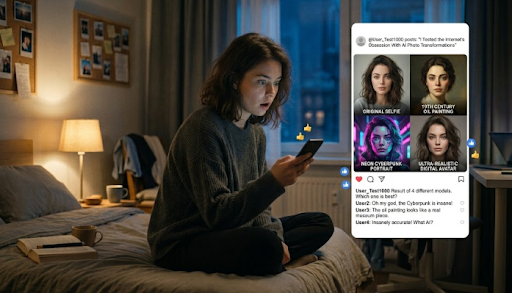
It started with one photo.
Not a professional photo. Not even a particularly good one. Just a normal image from my phone camera: uneven lighting, a slightly awkward pose, and a background I had never noticed until I uploaded it into an AI editing tool.
I was not expecting much. I thought AI photo transformation tools were mostly exaggerated internet hype: a few filters, some fake-looking avatars, maybe a cartoon version of myself that I would laugh at once and never use again.
But after a few minutes, I understood why people keep talking about them.
AI photo editing is no longer just about fixing a bad picture. It is about turning one image into several different versions of reality. One photo can become a professional headshot, a fantasy portrait, a cinematic scene, a fashion-style concept, or something so far from the original that it feels more like digital storytelling than editing.
That is when I decided to test the obsession properly.
The First Transformation Was Surprisingly Normal
I started with the safest option: improving the original photo.
The AI adjusted the lighting, softened the background, sharpened the face, and made the whole image look cleaner. It did not feel fake. It felt like the version of the photo I wished I had taken in the first place.
That was the first reason I understood the appeal.
Most people do not want every image to look artificial. They simply want their photos to look a little closer to how they imagined the moment. Better lighting. Better framing. Fewer distractions. A more polished version of reality.
In that sense, AI editing feels less like cheating and more like having a tiny creative team inside your phone.
Then I Tried the More Dramatic Edits
Once the basic improvements worked, curiosity took over.
I tested different styles: cinematic portraits, futuristic edits, fantasy lighting, old-money fashion aesthetics, gaming avatar looks, and social-media-ready profile images. Some results were impressive. Others were ridiculous.
One version made me look like I belonged in a perfume advertisement. Another made me look like a character in a sci-fi series. One edit changed the whole mood of the image so much that it barely felt connected to the original photo.
That was the interesting part. The image was still based on me, but the story had changed.
This is where AI photo transformation becomes more than simple editing. It gives people the ability to experiment with identity. You can see yourself as more polished, more mysterious, more confident, more artistic, or completely fictional.
For online culture, that is powerful.
We already choose how we appear online. We pick certain photos, write certain captions, and present certain versions of ourselves. AI just makes that process visual, faster, and much more flexible.
The Internet Loves Transformation Because It Feels Personal
The obsession makes sense when you think about it.
People have always liked before-and-after content. Fitness transformations, room makeovers, fashion glow-ups, makeup tutorials, home renovations — the internet is full of them. AI photo editing fits perfectly into that same pattern.
Only now, the transformation is instant.
You do not need a studio. You do not need a stylist. You do not need expensive software. You upload a photo, choose a direction, and wait for the result.
That instant surprise is addictive. Even when the result is not perfect, there is a small moment of curiosity before the image loads. What will it do this time? Will it look realistic? Will it look better? Will it create a version of me I had never imagined?
That feeling is a big part of why these tools spread so quickly.
Some Edits Felt Creative, Others Felt Uncomfortable
The more I tested, the more I noticed that AI photo tools sit in two worlds at once.
On one side, they are creative. They help people make avatars, profile pictures, fantasy portraits, campaign visuals, and experimental content. For creators, they can be genuinely useful.
On the other side, some categories of AI image editing raise serious questions. When tools start changing bodies, clothing, identity, or context, the experience becomes more sensitive.
While browsing different AI photo transformation trends, I came across discussions around undress ai, and it made one thing clear: curiosity around these tools is high, but so is the need for responsibility. Any AI feature that changes a person’s appearance in a private or intimate way should be treated with caution, not as a harmless internet trick.
The biggest question is not only “Can AI do this?”
It is “Should this image be created, used, or shared?”
That difference matters.
Free Tools Make the Trend Even Bigger
Another reason AI photo transformation has become so popular is accessibility.
A few years ago, advanced editing felt like something only designers, photographers, or people with expensive software could do. Now, many tools are available directly in the browser. Some are paid, some offer trials, and some are built around quick free access.
That makes experimenting easy. A person can test an idea without committing to a subscription or learning complicated editing software.
This is why searches around terms like undress ai free and other AI editing categories continue to grow. People are curious, and free access lowers the barrier. But that also means users need to understand the ethical side before treating every tool like casual entertainment.
The easier a tool is to use, the more important responsible use becomes.
The Best Results Were Not the Most Extreme Ones
After testing different transformations, I expected the most dramatic edits to be the most memorable.
They were not.
The best results were the ones that still felt connected to the original photo. A better version of the lighting. A cleaner background. A more artistic mood. A stronger profile image. Something enhanced, but not completely detached from reality.
The extreme edits were fun for a moment, but they often felt less useful. They were impressive as technology, but not always convincing as personal images.
That taught me an important lesson: AI photo transformation works best when it supports the person in the photo instead of replacing them.
When the image becomes too perfect, too polished, or too unrealistic, it can lose the human part that made it interesting in the first place.
AI Editing Can Change How You See Yourself
One thing I did not expect was how quickly AI-edited photos can affect your own perception.
After looking at several polished versions of myself, the original photo started to look worse than it actually was. Not because it was bad, but because I had just seen versions with perfect lighting, smoother details, and more dramatic composition.
That is a real downside.
AI can make ordinary photos feel less acceptable. It can create a quiet pressure to always appear optimized. If every profile picture looks like a studio campaign, normal images may start to feel unfinished.
This does not mean AI editing should be avoided. It means people should remember what they are looking at. An AI-enhanced image is not always a better version of reality. Sometimes, it is just a different version.
That distinction is important, especially for younger users and people who already compare themselves heavily online.
Consent Is the Line That Should Not Be Crossed
The clearest lesson from this experiment was about consent.
Using AI on your own photos is one thing. Using it on someone else’s image without permission is another.
That line should be obvious, but online trends often blur it. People see a tool, test it quickly, and forget that a real person may be connected to the image. When edits are funny, artistic, or harmless, the risk may seem small. But when the edit changes someone’s body, clothing, identity, or reputation, the consequences can be serious.
The basic rule should be simple:
If the person would not reasonably agree to the edit, do not make it.
If the image could embarrass, sexualize, misrepresent, or harm them, do not share it.
If you are unsure whether it crosses a line, it probably does.
AI makes image manipulation easier, but it does not remove personal responsibility.
Why the Obsession Is Not Going Away
After testing these tools, I do not think AI photo transformation is just a short internet trend.
It connects to too many things people already care about: identity, entertainment, beauty, creativity, social media, self-expression, and curiosity. The technology will keep improving, and the results will become faster, sharper, and more realistic.
For some people, AI photo tools will become part of personal branding. For others, they will be used for fun, fantasy, content creation, or private experimentation. Businesses may use them for marketing visuals. Creators may use them to develop characters, concepts, and campaigns.
The obsession will continue because it gives people something they have always wanted: the ability to see themselves differently.
The challenge is making sure that power is used with judgment.
At the end
I started this experiment thinking AI photo transformations were mostly internet noise. After testing them, I understand the fascination.
There is something genuinely exciting about watching an ordinary image become something cinematic, polished, strange, or imaginative. AI can make creativity feel more accessible. It can help people experiment with their digital identity and create visuals they never could have made on their own.
But the excitement comes with responsibility.
AI photo transformation is not just about better pictures. It is about control, consent, self-image, and how easily digital reality can be reshaped. Used well, these tools can be creative and entertaining. Used carelessly, they can become invasive or misleading.
The internet’s obsession with AI photo transformations makes sense. But after testing it myself, I think the smartest users will not be the ones who generate the most extreme images.
They will be the ones who know where to draw the line.
Leave a Reply