Authorized push payment fraud is one of the fastest-growing financial crime typologies globally. Regulators in the UK, EU, Singapore, and Australia now hold banks liable for reimbursing victims in many scenarios. The attack pattern always starts the same way. A phishing email, a fake invoice, a spoofed executive message, or an impersonated support agent convinces a legitimate user to authorize the transfer themselves. Because the customer initiated the payment, traditional fraud controls often let it through.
Stopping this pattern requires defenses that work upstream of the payment. It requires visibility into the phishing infrastructure, the endpoint compromise, and the email trail that made the fraud possible. That is where managed xdr plays a role that isolated fraud tools cannot.
How authorized push payment fraud actually unfolds
Understanding the attack sequence explains where defenders can intervene. In a typical authorized push payment fraud scenario, the attacker first identifies a target through open source reconnaissance or a prior data breach. They then deliver a lure. It could be a phishing email that impersonates the CEO, a fake supplier invoice, a compromised email thread hijacked mid-conversation, or a spoofed bank support call.
The victim believes the request is legitimate. They authorize the transfer themselves, usually to a mule account controlled by the fraud network. Funds move through layered accounts within minutes and are cashed out through crypto exchanges, prepaid cards, or foreign banks before recovery is possible.
Because the customer initiated the payment, transaction monitoring based on customer behavior alone often approves it. The compromise happened earlier, at the email layer, the endpoint, or the identity layer. That is exactly where extended detection and response has an advantage.
Where Managed XDR interrupts the attack chain
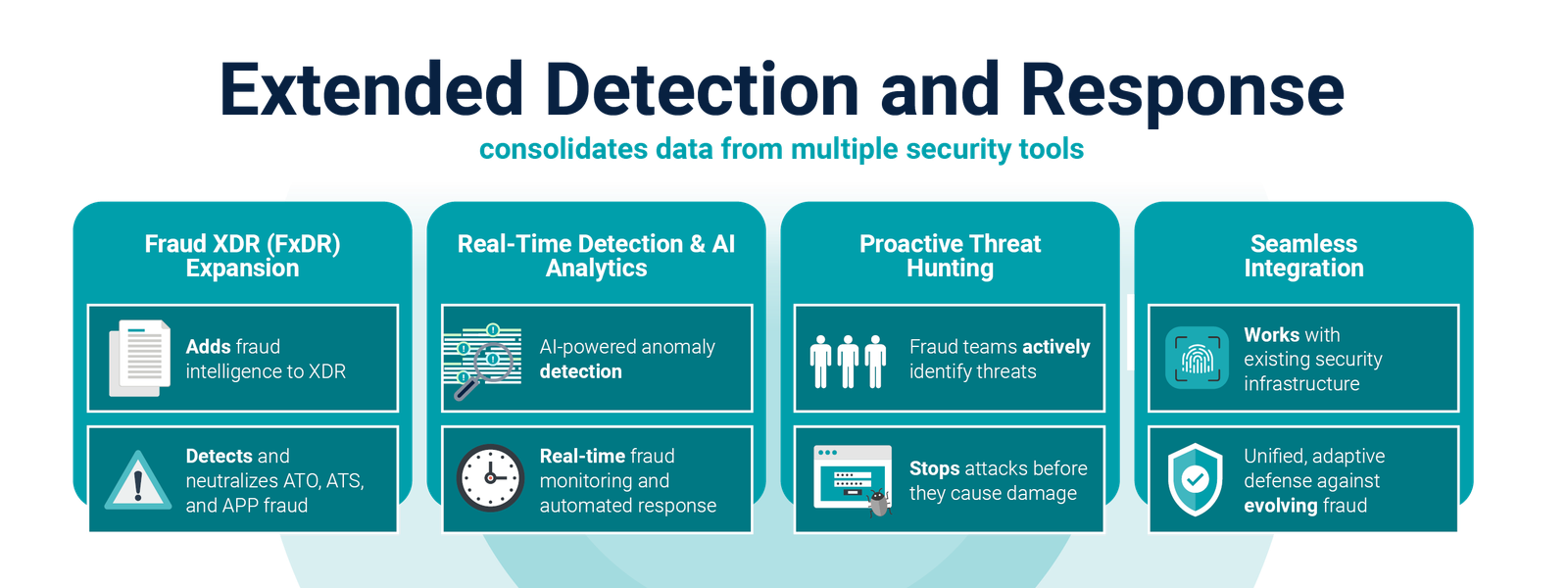
Group-IB Managed XDR correlates telemetry across endpoint, network, email, and cloud. This cross-surface view catches the precursors to authorized push payment fraud that a single-domain tool would miss.
On the email layer, the included Business Email Protection module analyzes attachments and links in a sandbox that mirrors the target’s environment. Payloads that would evade a generic sandbox detonate here. Business email compromise threads are flagged based on attribution to known actor groups, not just heuristic tone analysis. This stops the initial lure before the user ever sees it.
On the endpoint, behavioral machine learning classifiers detect the follow-on activity that often accompanies invoice fraud. Remote monitoring tools installed by attackers, credential dumping utilities, and unusual browser process trees are surfaced in real time. When a finance employee’s workstation shows these indicators, the security team can intervene before that employee is manipulated into initiating the payment.
On the network layer, encrypted traffic analysis identifies command and control communications from compromised hosts. Session data from suspicious identity providers or unusual geographic authentications feeds the same correlation engine, giving analysts a full picture of the account and device state before any transaction is processed.
The analyst layer that transaction monitoring lacks
Managed XDR is not just tooling. It is a 24/7 analyst-led service. Group-IB’s security operations team triages the alerts, investigates the context, and executes containment playbooks. For authorized push payment fraud specifically, that means when an analyst sees a business email compromise indicator on a finance user’s mailbox, they can quarantine the thread, revoke active sessions, and alert the fraud operations team before the payment leaves the account.
This human oversight is what turns raw telemetry into fraud prevention. Rules and models catch known patterns. Analysts catch the novel ones, and they connect the endpoint indicator to the payment attempt in time to matter.
Integration with fraud operations
The value multiplies when Managed XDR outputs feed the fraud team directly. Group-IB’s Unified Risk Platform connects endpoint detections, email compromise indicators, and threat intelligence to Group-IB Fraud Protection. A confirmed business email compromise on a finance user can automatically raise the risk score on any payment initiated from that user for the next several hours. A stealer infection on a customer device can trigger step-up authentication on high-value transfers. These are decisions that require both worlds talking to each other, and that is what unified telemetry delivers.
What good looks like in practice
The Fawry deployment in Egypt is a useful reference point. Continuous managed detection combined with intelligence-driven fraud controls produced measurable reductions in both intrusion dwell time and downstream fraud losses. The lesson is not about a single technology. It is about closing the gap between the compromise event and the payment event, so that defenders act while attackers are still in the setup phase rather than after the money has moved.
Authorized push payment fraud will keep growing as long as payments settle faster than fraud tools react. The way to shrink it is to move detection upstream, into the email and endpoint layers where the compromise begins, and to keep human analysts in the loop when models are not enough.
Leave a Reply