Not every network project can run on standard, off-the-shelf cable. Distance requirements, environmental conditions, and connector standards vary from one installation to the next, which is why custom fiber optic cables have become essential for telecom operators, ISPs, and structured cabling companies worldwide.
This article breaks down what customization actually means, what options are typically available, and what to look for in a manufacturer capable of delivering it.
Why Standard Cables Don’t Always Work
Fiber optic cables are valued for their ability to carry large volumes of data over long distances with very little signal loss. But a cable designed for indoor structured cabling won’t necessarily hold up in an outdoor aerial installation, and a cable built for a data center won’t always suit a rural FTTH rollout.
This is where custom fiber optic cables come in. Instead of forcing a project to fit a generic product, manufacturers can adjust the cable’s construction to match the exact environment and performance requirements.
Key Areas of Customization
Fiber Core and Cladding
Core and cladding diameters can be adjusted to optimize signal performance for a specific application, whether that’s short-distance indoor runs or long-haul outdoor transmission.
Fiber Count
Projects rarely need the same number of fibers. Customization allows the exact fiber count to be specified, so networks are neither under-provisioned nor paying for unused capacity.
Jacket Materials
Cable jackets can be built from PVC, LSZH (Low Smoke Zero Halogen), or armored materials, depending on whether the installation is indoors, outdoors, or in a high-risk fire-safety environment.
Cable Length
Cables can be manufactured to precise length specifications, reducing waste and ensuring a clean fit during installation rather than relying on standard reel lengths.
Connectorization
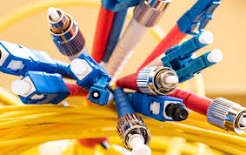
Pre-terminated cables are available with a range of connector types, including SC, LC, ST, and MPO, simplifying installation and reducing on-site termination work.
Where Custom Fiber Optic Cables Are Used
Custom cabling supports a wide range of modern infrastructure projects:
- FTTH (Fiber-to-the-Home): Requires cables with high-quality silica cores, protective jackets, and enough flexibility to handle residential installation conditions.
- Smart city networks: Depend on cabling that can support increasing bandwidth demands while resisting signal interference.
- Data centers: Need high-bandwidth cables with configurations that can scale as storage and computing demands grow.
- 5G base stations: Require low-latency cabling capable of handling the high data volumes associated with 5G networks.
What to Look for in a Manufacturer
Customization is only as good as the manufacturer behind it. A few factors are worth checking before committing to a supplier:
Experience and industry relationships matter, since manufacturers with years of accumulated expertise and strong ties to major fiber producers tend to have more reliable production processes.
Certifications such as CE, ROHS, and CPR indicate that products meet recognized international safety and performance standards.
In-house R&D capability allows manufacturers to offer genuine ODM and OEM services rather than simply relabeling existing products.
Quality control processes, including IQC, IPQC, FQC, and OQC checks throughout production, help ensure consistency across large orders.
The Customization Process
A well-structured custom order typically follows several stages: understanding the customer’s requirements, designing the cable structure, confirming key specifications, developing samples, testing and verifying performance, and finally moving into bulk production with ongoing support.
Working with a manufacturer that follows a clear, documented process reduces the risk of miscommunication and ensures the final product matches the original specification.
Final Thoughts
Custom fiber optic cables give network operators and integrators the flexibility to match cabling precisely to their project’s environment, distance, and bandwidth needs. From core and cladding selection to jacket material and connectorization, every detail can be tailored rather than compromised.
Choosing a manufacturer with proven experience, strong certifications, and a transparent customization process is the key to getting cables that perform reliably, whether the project is a residential FTTH rollout or a large-scale 5G deployment.
custom fiber optic cables
Leave a Reply