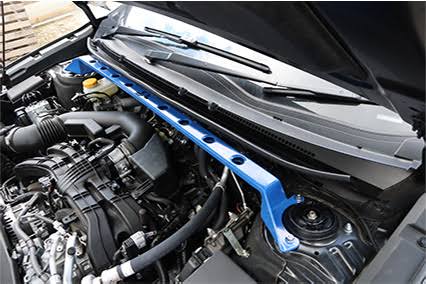
Suspension upgrades get all the glory in car builds. Coilovers, big sway bars, and performance shocks dominate the conversation, while one of the cheapest and most effective handling modifications sits quietly in the background: a metal bar bolted across the engine bay. Ask enthusiasts what finally made their upgraded suspension feel “connected,” and a surprising number will point to that bar.
The Problem: Your Chassis Is Flexing
Here’s what most drivers never consider. When you corner hard, the suspension loads don’t just compress springs and shocks; they push and pull on the towers where those components mount to the body. On unibody cars, which is nearly everything built in recent decades, those towers can actually move relative to each other as the body flexes. Only fractions of an inch, but that’s enough to change your suspension geometry mid-corner, which means your alignment, your tire contact patch, and your steering response are all shifting exactly when you need them steady.
Strut tower braces attack this problem directly. By connecting the towers with a rigid steel bar, the brace ties both sides of the chassis together so cornering loads can’t spread the towers apart. The geometry your alignment shop set stays put, even under aggressive driving.
What You Actually Feel
The improvements show up where flex used to live. Steering becomes more direct, with better feedback about what the front tires are doing. Turn-in sharpens because the chassis stops absorbing the first moment of steering input. Traction improves under hard acceleration and cornering since the tires keep more consistent contact with the road. And the car simply behaves more predictably during emergency maneuvers, which is a safety benefit hiding inside a performance part.
Two groups feel the difference most. The first is anyone who has already upgraded to performance shocks or coilovers: those components can only work as well as their mounting points allow, and a flexing tower quietly robs an expensive suspension of its precision. A brace is the cheap part that unlocks the expensive parts. The second group is classic and muscle car owners, whose chassis were designed in an era when rigidity simply wasn’t the engineering priority it is now. On older metal, modern chassis reinforcement delivers some of the most dramatic gains available per dollar.
The Installation Reality
Part of the appeal is how little commitment this modification demands. Quality braces are engineered around factory mounting points, installed as a direct bolt-on with no drilling, cutting, or welding. The good ones are also designed with the engine bay in mind, mounting above major components so oil changes and routine service stay unobstructed. An afternoon with hand tools covers most installations, though having a shop torque everything to spec never hurts.
When shopping, the details that separate quality from shelf filler are construction and fitment. Look for heavy-duty steel rather than decorative aluminum, CNC-machined mounting plates that distribute load properly, corrosion-resistant finishes, and braces engineered for your specific vehicle rather than “universal” bars that fit everything approximately and nothing well. Established American manufacturers with decades in suspension engineering and real technical support are worth the modest premium.
The Bottom Line
A strut tower brace won’t add horsepower and won’t change your car’s stance, which is probably why it gets overlooked. What it does is subtler and arguably more valuable: it makes everything else work the way it was designed to. For the price of a nice dinner out, few modifications return more genuine handling improvement, and almost none return it this easily.
Leave a Reply